PotDrive Documentation
Storage middleware for Portaldot V3
PotDrive writes files into Portaldot's own TransactionStorage pallet, addresses them with standard IPFS CIDs, and lets any reader verify every byte against its hash.
Portaldot V3 runs TransactionStorage, the pallet behind Polkadot's Bulletin chain. Block producers keep stored data for 100,800 blocks and must prove they still hold it. The node serves it by CID over a bitswap RPC. Before PotDrive there was no SDK, gateway or app for it, and it held no data.
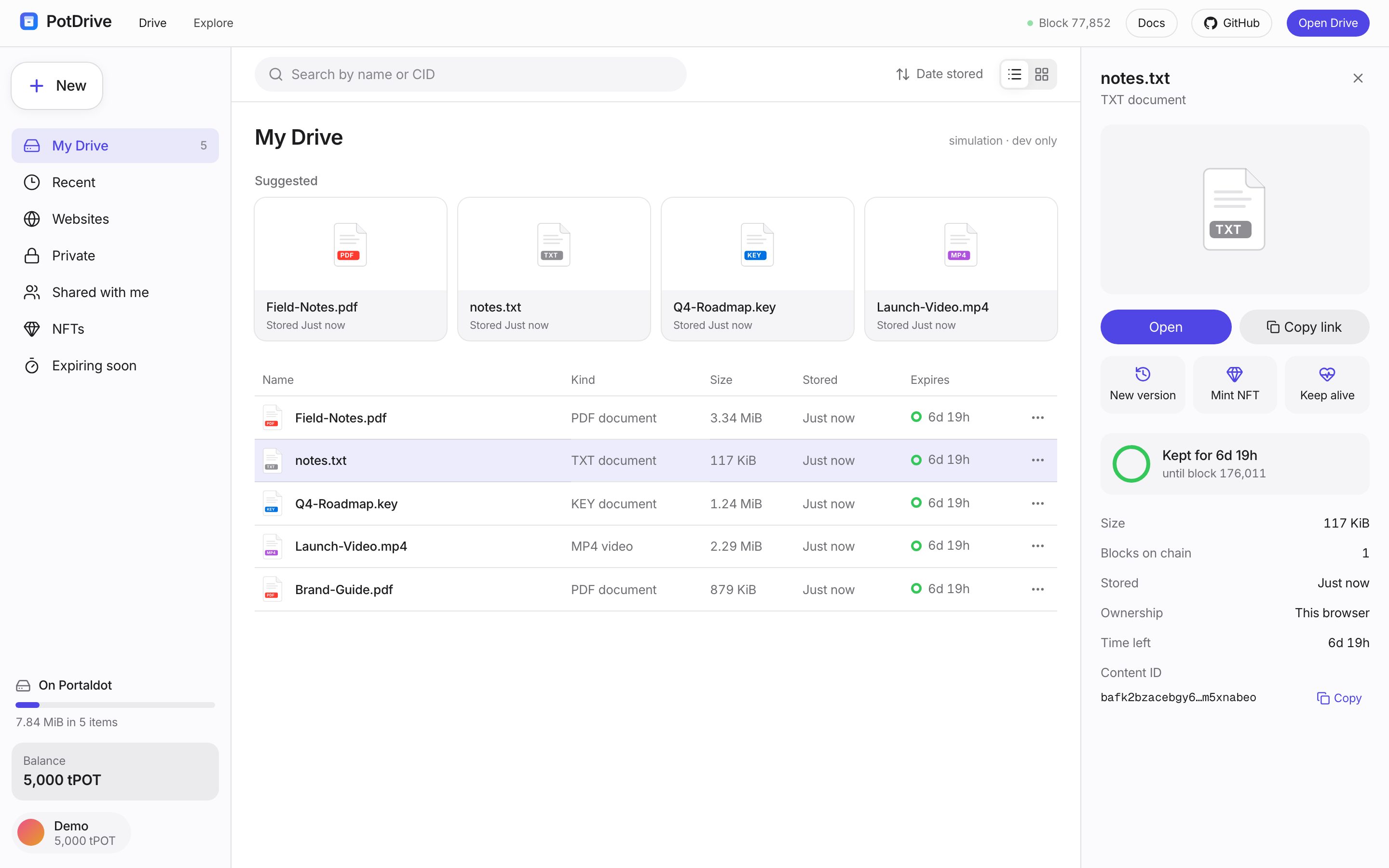
PotDrive is the missing layer on top of that pallet:
- Content-defined chunking (FastCDC) with chain-level deduplication, so a new version of a file only pays for what changed.
- One-signature uploads for any number of blocks, through a throwaway in-tab upload key.
- UnixFS files and folders, including static websites served from the chain.
- Verified reads everywhere: the Drive, the gateway, the SDK and the CLI re-hash every block.
- A Solidity registry on Revive for ownership and prepaid keep-alive, called from the same Polkadot wallet.
Architecture
Browse the docs
Store your first file from the Drive, the SDK or the CLI.
How Portaldot holds data: indexing, retention, renewals and storage proofs.
Blake2b CIDs, UnixFS DAGs, FastCDC chunking and deduplication.
The upload key, its lifecycle, and why blocks can't share a batch.
What a reader checks, what it trusts, and what validators prove.
Upload with 0 tPOT: a relay pays through Portaldot's MetaTx pallet.
New versions link to the old one and only pay for blocks that changed.
Client-side AES-256-GCM, the envelope format and share links.
Seal a private file's key to another address with X25519 inbox keys.
Mint on Portaldot's native Nfts pallet with media stored on Portaldot.
Deploy a static site as a UnixFS directory and serve it from the chain.
Prepaid renewals and the keeper that spends them.
Every exported function, with signatures and examples.
put, get, deploy, info, renew and ls.
usePotFile, <PotImage> and <PotVideo>: verified files in any React app.
Let AI agents read, store and deploy on Portaldot.
HTTP routes, Range requests, headers and status codes.
Solidity on Revive that hashes with Portaldot's blake2b, decodes UnixFS and checks wallet signatures.
Threats, what PotDrive does about each, and what it doesn't.
Measured fees, sizes, retention and known constraints.